Translation management for developers.
Comvi is an MIT i18n library with bindings for six frameworks, and a platform where translators edit text on the page itself. Keys stay in your code. With CDN delivery on, the platform redeploys your project a few seconds after the last edit.
MIT React, Vue, Svelte, Solid, Next.js, Nuxt GitHub
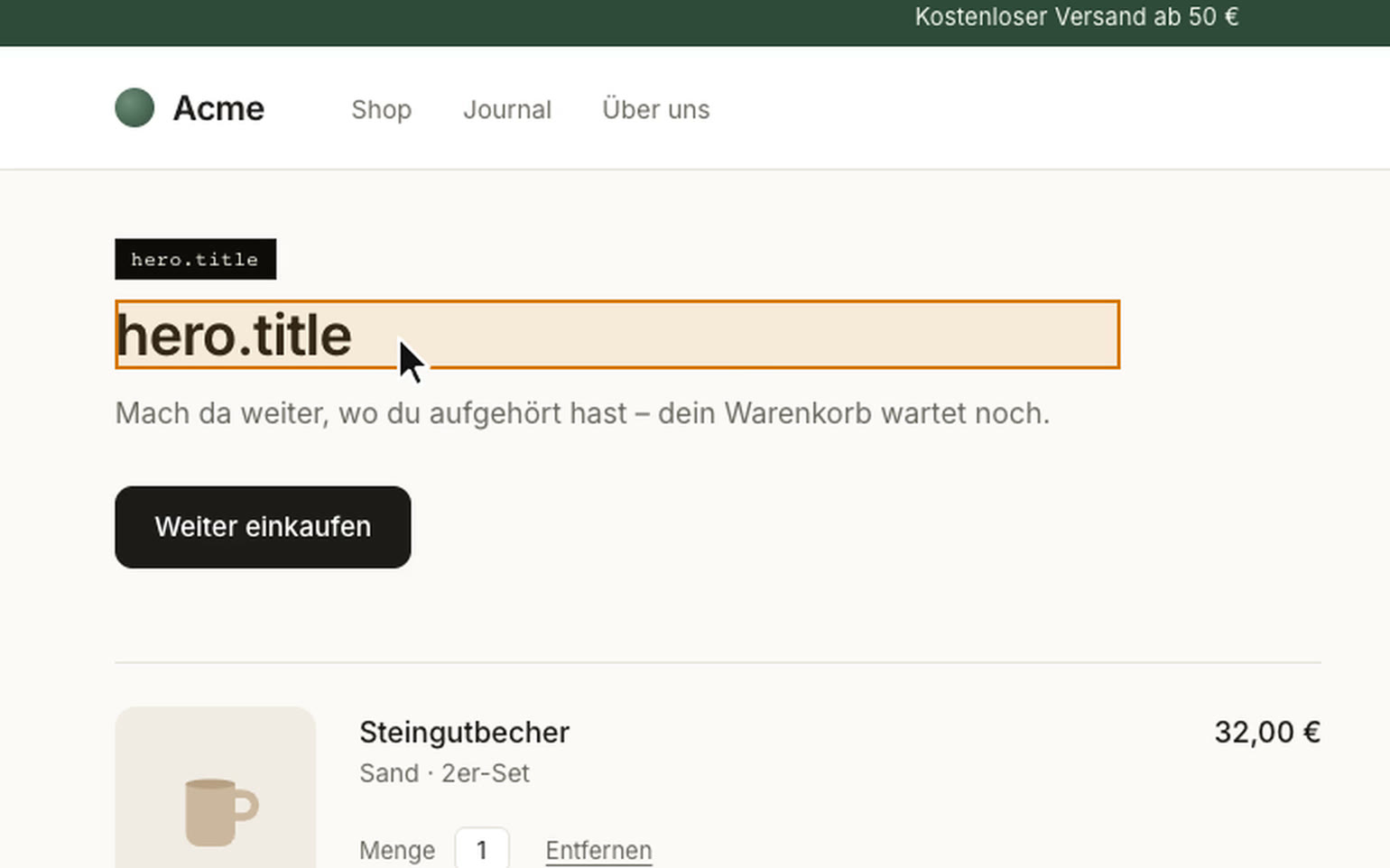
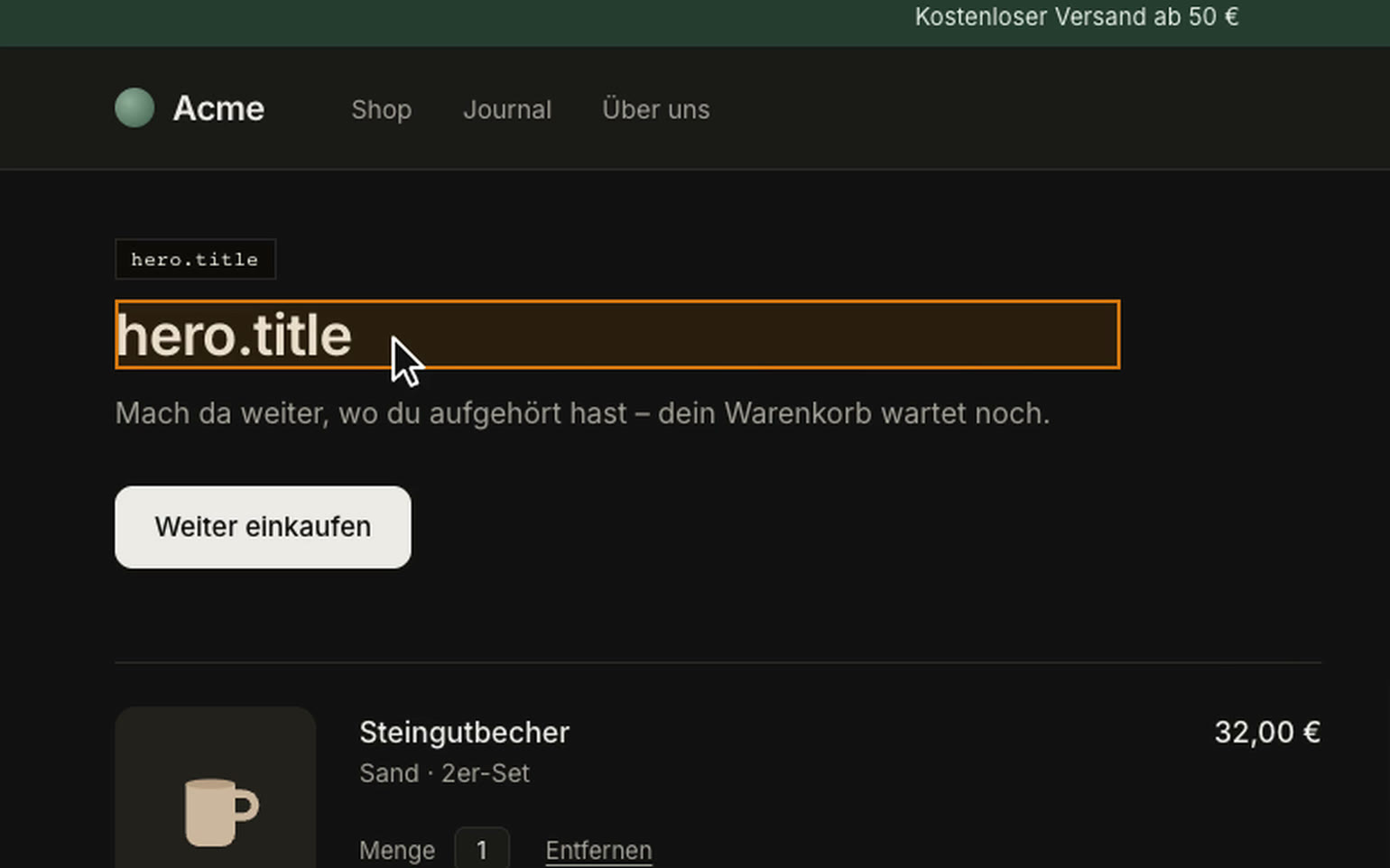
What happens after Save
An in-context editor for translators. A CDN for delivery. Type-safe keys for developers. Translation memory and a glossary that hold AI drafts to your terminology.
In-context editing
Edge delivery
AI translation
Type-safe keys
t('cart.sumary') fails tsc, and so does a missing ICU parameter. Keys and params are generated types.ICU plurals, rich text, and tags.
Fully type-checked.
The library behind our platform, available standalone. Write ICU messages with tags and parameters — TypeScript catches missing handlers at build time. Bindings for React, Vue, Solid, Svelte, Next.js, and Nuxt. MIT-licensed.
- Auto-types
- Vite plugin regenerates TS types on save
- Rich text
- ICU plurals + interpolation + tags in one expression
- Bundle
- No third-party code in your browser bundle
- 6 frameworks
- React, Vue, Solid, Svelte, Next.js, Nuxt
- Open source
- MIT, on npm, forkable
                1
                // messages/en.json

                2
                // "cart.summary": "{count, plural,

                3
                //    one {<b>#</b> item from <link>store</link>}

                4
                //    other {<b>#</b> items from <link>store</link>}}"

                5


                6
                import { T } from '@comvi/react'

                7


                8
                <T i18nKey="cart.summary" params={{ count: 3 }}

                9
                  components={{

                10
                    b: ({ children }) => <strong>{children}</strong>,

                11
                    link: ({ children }) => <a href="/store">{children}</a>,

                12
                  }}

                13
                />
Free to start. Your price is held while you subscribe.
Keys-based pricing. Team seats included. Scale with add-ons when you need more.
- 500 keys
- 2 members
- 2 projects
- Unlimited languages
- 3,000 keys
- 5 members
- Unlimited projects
- Unlimited languages
Common questions
Yes. Comvi i18n is MIT-licensed and works as a standalone i18n library: install it from npm and point it at your JSON files. The platform adds the in-context editor, member roles, translation memory, and edge delivery when you need them.
Yes. Export as JSON, which keeps ICU MessageFormat values as they are for react-intl and other ICU libraries, or as i18next v4, which converts ICU to i18next plural and context suffixes. The CDN serves plain JSON. The in-context editor, generated key types and tag handlers need the Comvi i18n library. The CLI reads and writes ICU JSON only, so an i18next project imports and exports through the dashboard.
Your nested or flat JSON imports without restructuring. i18next files are converted to ICU on import; vue-i18n's pipe plurals and @:linked messages you rewrite yourself, so {count} item | {count} items turns into {count, plural, one {# item} other {# items}}. In Vue, $t() and useI18n() stay and <i18n-t> becomes <T>.
Yes. The editor runs in the browser only; server-rendered HTML from Next.js or Nuxt hydrates as usual. A translator opens the page with the Chrome extension and an API key of their own, so your app only needs the small devtools() capability and no key in the bundle. For staging, use a separate project with its own API key, so edits land where you expect.
Only if you let them. An edit from the in-context editor is saved as Needs review. Once CDN delivery is on, its default filter ships every status, and a deploy is scheduled five seconds after the last edit; set the filter to Translated and nothing goes out until an editor or manager approves it. Translators cannot approve their own work.
Comvi i18n ships native bindings for React, Vue, Solid, Svelte, Next.js, and Nuxt. The framework-agnostic core works with anything else.
For the initial integration, yes. After that, translators and managers work in Comvi without touching code.
EU-hosted, GDPR compliant. We don't sell your data and we don't train AI on your content.